I have a friend who is convinced that every company is inherently evil, because they put profits ahead of people. I admit, it does sometimes feel this way sometimes, especially when you dive deep into what some of them are doing, but then there are some companies really do try to help out, while also making themselves billions. The two don’t have to be mutually exclusive.
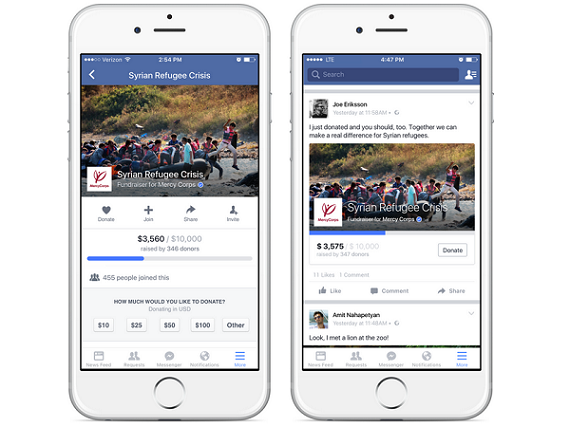
Take Facebook, for example. On Wednesday the company announced a new feature called Fundraisers, a tool to help non-profits to raise money directly from their Facebook page.
That means that they can now launch themed campaigns and special projects, rally their supporters, and track their progress toward a goal for year-end drives.
In order to allow them to raise that funding, Facebook also revealed that it is expanding its Donate button so that organizations will be able to attach a donate button to both pages and posts. That will allow consistency across the site, and it will expand where users can donate from by allowing them to give directly from their news feed.
Facebook already has a slew of partner organizations currently testing these features, 37 in all so far, including Mercy Corps, National Multiple Sclerosis Society and World Wildlife Fund.
It’s probably easy for people to be cynical about this move. VentureBeat, for example, thinks this is a way for Facebook to gain access to more payment information after it launched peer to peer payments on Messenger earlier this year.
There’s also the fact that Facebook launched a Donate Button in 2013, then a Buy Button in 2014, meaning that it could easily do something similar with Fundraisers, like become a competitor to Kickstarter.
Maybe I’m naieve, but I like to believe that, for Facebook, these moves seems to be a geniune desire to help people.
“With more than 150 million people around the world connected to a cause, Facebook is a global community of volunteers, donors and activists coming together to make the world a better place,” the company wrote.
“People raise money for disaster relief, they search for missing children, and they bring attention to the issues they care about. We’ve seen from our community that when people take action, lives are changed. We know we can do more to enable these connections.”
Silicon Valley gives back
Truly altruistic or not, non-profits will benefit from this feature. Facebook is far from the only tech company to give back.
Last year Twitter announced a homeless learning shelter called The NeighborNest, which will be located directly across the street from Twitter’s headquarters at the Essex Fox Plaza, and then revealed that it was going to pledge at least $3 million to nonprofits in San Francisco over the next four years.
The company had donated a combined $360,000 over the last two years. By 2018, it will be donating nearly a $1 million alone.
Last year Uber launched a new non-profit ridesharing program in Beijing called “People’s Uber,” where riders only cover the driver’s costs. The company expanded the feature to more parts of China.
In May, messaging startup Wickr announced that it was splitting into two companies,
keeping its encrypted messaging platform, while also launching a new non-profit organization called Wickr Foundation, which it said will be “dedicated to supporting a strong free society by championing private communications and freedom of information through the Private Web.”
When it comes to charitable giving, though, Mark Zuckerberg and his wife Priscilla Chan are pretty much the gold standard in the tech world, as they were named the most charitable people in 2013, having donated 18 million shares of Facebook stock, which amounted to a total of $992.2 million.
A big portion of their charity has so far gone toward education. Zuckerberg founded the Startup: Education foundation in Newark, New Jersey, and personally donated $100 million to the Newark public school system. In December of last year, Startup: Education, along with Bill Gates’s The Gates Foundation, participated in a $9 million philanthropic investment in EducationSuperHighway, a non-profit aiming to help K-12 schools get connected to reliable, high-capacity Internet access. Zuckerberg also donated $120 million to Bay Area schools.
He also gave $25 million to the Center for Disease Control to help fight the Ebola virus when that was all over the news.
(Image source: newsroom.fb.com)