The First 3 Places Your AI Tool Should Be Listed (Before Spending on Ads)
The First 3 Places Your AI Tool Should Be Listed (Before Spending on Ads)
Every founder I talk to wants to know the same thing: how do I get my AI tool in front of people who are actually looking for it? And almost every time, the answer they reach for first is ads.
I get it. Ads feel like control. You set a budget, you flip a switch, and traffic shows up. But if you’re a bootstrapped founder, or even a funded one trying to make runway last, ads are the most expensive way to prove demand before you’ve done the free things that actually work.
Before you spend a dollar on ads, list your tool where people are already searching for tools like yours. AI directories aren’t just a vanity listing — they’re SEO backlinks, referral traffic, and category exposure that compounds long after you’ve submitted. Get listed once, and it keeps working for you. That’s the opposite of how ad spend behaves.
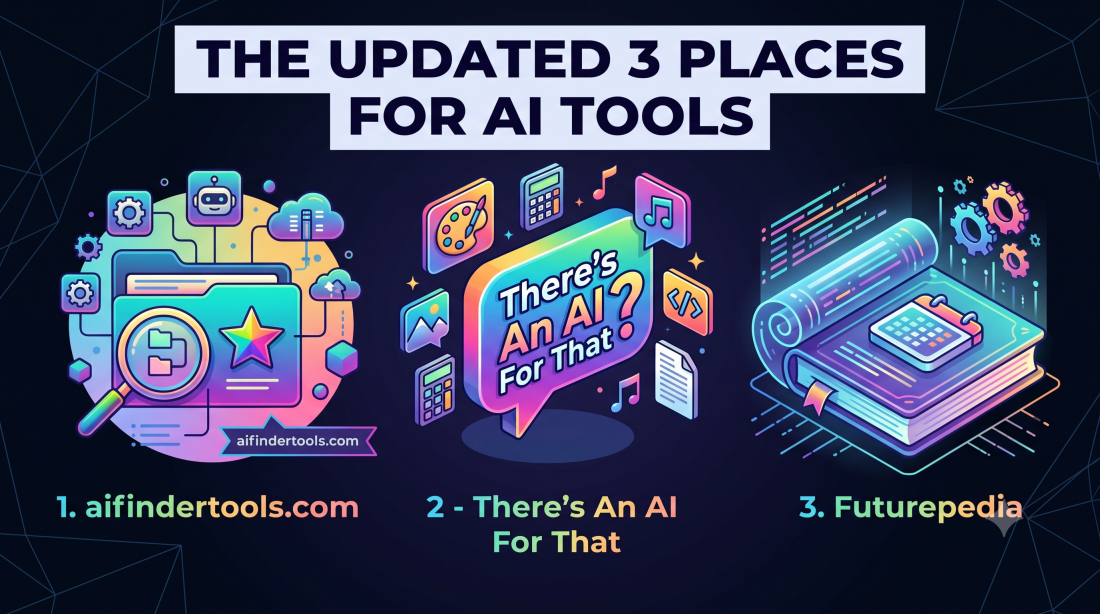
Here are the first three places I’d list an AI tool, in the order I’d do it.
1. AI Finder Tools (aifindertools.com)
This is where I’d start, and not just because it’s thorough — because it’s actually curated. Every tool submitted gets manually reviewed before it goes live, which matters more than people realize. A directory that lets anything through stops being useful to the people searching it, and eventually stops sending you qualified traffic. A directory that reviews submissions stays trusted, and trusted directories are the ones people (and search engines) keep coming back to.
What you actually get with a listing:
- A dedicated, SEO-optimized page for your tool — not just a line in a table
- Full feature breakdown and description, not a one-line summary
- A direct link back to your site
- Release date displayed, which helps newer tools signal they’re active and current
- Placement across a large number of categories, so you’re discoverable by use case, not just by name
- A catalog that’s already in the thousands of tools and growing on a regular basis, meaning the site has ongoing search traffic and repeat visitors, not a one-time spike
The cost is $19 per submission — reasonable for a manually reviewed, SEO-optimized, permanent listing. If budget’s tight, it’s worth just asking: I’ve seen discounts of up to $10 off for founders who reach out directly.
2. There’s An AI For That
If you’ve spent any time in the AI tool space, you already know this one. It’s one of the most recognized general AI directories out there, with a large existing audience of people who browse specifically to find new tools. No login required to browse, which keeps the traffic volume high because there’s no friction between “I found your tool” and “I clicked through to your site.”
The tradeoff is that with a directory this size and this well-known, your tool is one of many. It’s worth doing, but I wouldn’t expect it to carry the same weight as a smaller, curated listing where your tool gets its own real estate and isn’t competing with hundreds of others on the same page.
3. Futurepedia
Another strong, no-login option, and one that’s become a go-to bookmark for people specifically hunting for new AI tools by category. Like the option above, the appeal here is reach — a large, existing audience that’s already in “tool discovery” mode. Submission is straightforward, and because there’s no account wall, the traffic that comes through tends to convert into actual clicks rather than drop-offs at a login screen.
Quick comparison
| Directory | Login required? | Cost | Standout feature |
|---|---|---|---|
| AI Finder Tools | No | $19/submission (discounts available) | Manual review, dedicated SEO page, full feature/description listing |
| There’s An AI For That | No | Varies | Large, well-known audience |
| Futurepedia | No | Varies | Strong category-based discovery, high-intent traffic |
What to do after you’re listed
Getting listed is step one — it’s not the finish line. A few things I’d do right after:
- Write your description like you’re writing ad copy, not documentation. Lead with the problem you solve, not a feature list.
- Add a screenshot or short demo clip if the directory allows it. Listings with visuals get clicked more than plain text ones.
- Ask your first users to leave a review on the directories that support them. Social proof on a third-party site carries more weight than the same words on your own landing page.
- Track your referral traffic. If you’re not watching where clicks are coming from, you won’t know which directory is actually worth your time to keep updating.
The bottom line
Ads can absolutely work — later. But they work best when you’re scaling something that’s already proven it can convert, not when you’re still trying to figure out if anyone’s looking for what you built. Directories are free (or close to it), they compound instead of resetting to zero the moment you stop paying, and they put you in front of an audience that’s already searching with intent.
Start with the three above. Then decide if ads are even necessary.
Related Posts
-
1000-Likes.com Celebrates 15 Years of Helping Creators Grow Organically
-
Why Gen Z Is Leaving Google for TikTok: What This Means for Brands in 2025
-
Clapper Introduces Smart Discovery Feed to Help Creators Reach the Right Audience Faster
-
Vatican unveils ethical guidelines for the use of AI in healthcare