
We may be coming to the end of Women’s History Month, but that doesn’t mean that we should stop doing stories about how hard it is for women to get ahead in tech.
Its only in the last few years that we’ve really started to hear about the gender pay gap, or the trend of men getting paid more than women to do the same job. It’s been somewhat controversial, and I have seen numerous people try to dispute the notion.
Not only is the gender pay gap real, though, it’s worst for women who get into the highest ranks in technology.
In the United States, there is a 24.1 percent overall advantage for male workers. That means that women are being paid, on average, 75.9 cents for every dollar their male co-worker makes, according to data in a report from Glassdoor this week.
That’s higher than the United Kingdom and Germany, both of which still have a gap of over 20 percent, Australia, with a 17.3 percent gap, and France, which has a pay gap of 14.3 percent.
Obviously the gap is not going to be the same across every industry, or every job. When it comes to tech, it actually has the job with the biggest gap of all.
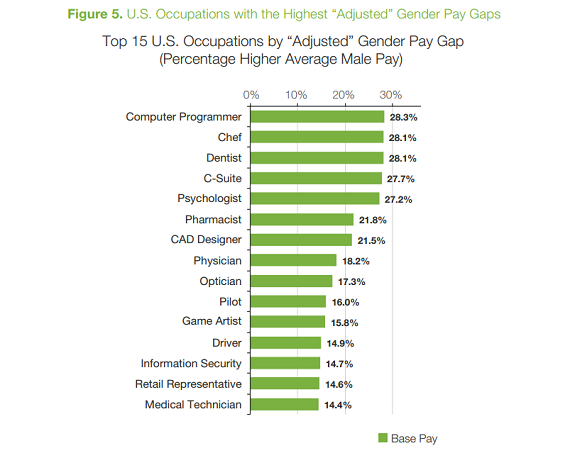
The average amount that male programmers in the US earn over their female counterparts is a whopping 28.3 percent, meaning they come close to make almost a third more than the women they work with. That barely beat out chef and dentist, each with a gap of 28.1 percent.
This means women are earning, on average, only 72 cents per dollar earned by men, even when controlling for all differences between jobs, companies and workers. That means the gap is nearly five times larger than the U.S. average “adjusted” gender pay gap of 5.4 percent.
Computer programmers also happen to be 81 percent male, by the way.
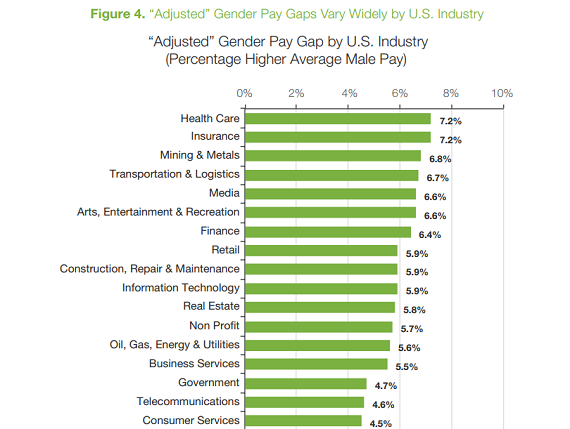
 That really does not make tech look like a very welcoming place for women. If there’s any consolation it’s that the gap in the tech industry as a whole is much smaller, 5.9 percent, putting it in a tie at ninth place with retail and construction. That means its pretty much the average in the United States.
Yeah… that doesn’t make anything better at all.
This may seem like an insurmountable problem, and it is a big one, but some of the biggest companies have been trying to fix it.
In October of 2014, Facebook, Box and Pinterest announced that they had gotten together to launch a new mentorship program called WEST (Women Entering and Staying in Tech). The idea is to get more women interested in computer science, and to help them be prepared for the tech jobs of the future.
WEST features women who have technical jobs at all three companies, who will serve as one-on-one mentors. They will meet with mentees individually and as a group, in-person and online, over the course of a year.
In January of last year Intel announced it was investing $300 million to “build a pipeline of female and under-represented engineers and computer scientists,” as well as to actively support hiring and retaining more women and under-represented minorities.
Intel also revealed its plan to fund programs that celebrate diversity, including the International Game Developers Association, the E-Sports League, the National Center for Women in Technology, the CyberSmile Foundation, the Feminist Frequency, and Rainbow PUSH.
Vator has also attempted to tackled this issue during our “When will tech look like America” panel in April of last year, which featured Freada Kapor Klein, Co-Founder of Kapor Center; Libby Schaaf, Mayor of City of Oakland; Kimberly Bryant, Founder of Black Girls Code; Nilka Thomas, Manager of Global Diversity and Talent Inclusion, Google; and Lisa Lee, Senior Diversity Manager at Pandora.
However, even when companies try their best to be inclusive, they still can’t solve the problem all at once. Microsoft, for example, saw the number of minorities, and women in tech roles, increase between its report in 2014 and 2015, it also lost 2 percent of its female workers at the same time.
While even getting women into high paying tech jobs is one aspect on increasing diversity, things do seem to be getting a little better on the side of the equation, with female founders seeing historic dealshare in 2015, with 17.5 percent of all deals going to a company with at least female founder. The number is still obviously too low, but it has increased every year since at least 2006.
There’s also a growing trend on the investor side of firms that cater only companies that are founded by women.
We’ve got a long way to go before tech seems actually inclusive, but at least people are talking about the problem, and trying to make changes.
(Image source: meridianwealth.com)