When I think of a social media company with a family of mobile apps, I think of Facebook, and for good reason: they have created a whole host of consumer-facing apps, including Messenger, Slingshot, Rooms, and more.
LinkedIn also has a family of apps, around 11 now, but I’d be lying if I said that I had ever used any of them. That’s because they are almost all enterprise focused.
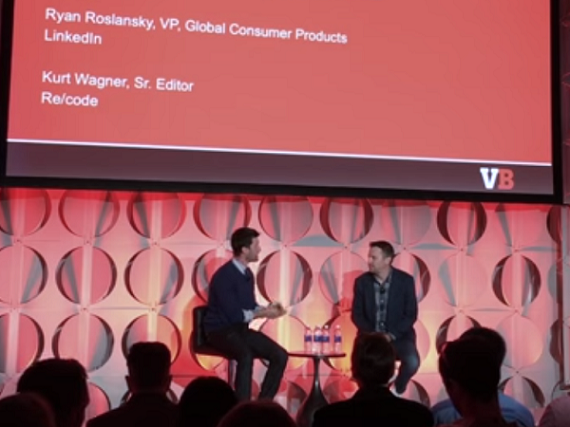
On Tuesday, LinkedIn’s head of consumer products, Ryan Roslansky, spoke with Re/code’s Kurt Wagner talk at VentureBeat’s Mobile Summit, where he dove more into that strategy and why the company has put its focus on that side of the business.
“It’s a strategy that we’ve been working on for four plus years now,” Roslansky said, and it is built upon a huge amount of data that LinkedIn has been able to gather from all of the professionals and companies that have joined the site.
“When you think about the scale we have right now, we’ve got over 400 million members, growing at about two per second on LinkedIn, with all this data going back and forth, it gives you massive optionality to build really cool stuff on top of this economic graph,” he said.
It has also allowed the company to build a bunch of different businesses, including one for recruiting, a sales business, a marketing business and, more recently, thanks to the $15 billion acquisition of Lynda.com last year, a learning business as well.
That’s a lot to put onto a single app, though, Roslansky said.
“That’s the challenge, that you have this graph of information, with a lot of use cases on top of it. On the desktop its fairly simple to add another tab, or throw another link in there. But when it comes down to a mobile device which, at the end of the day, should provide a pretty seamless experience, the same thing that, someone trying to upload their profile or work on their resume, it’s a much different use case from a professional recruiter who’s trying to bang on the graph to find people to hire for certain jobs,” he told Wagner.
“So we started to break apart those use cases into a variety of apps, and that’s why you see a lot of apps in the App Store. We found that, for a lot of the professional enterprise-type use cases, like a recruiter or a salesperson or a marketer, who’s using LinkedIn as a premium product to access that graph, we found a strong use case there.”
In terms of LinkedIn ever doing the same with its consumer-facing tools, it doesn’t seem very likely that it would go in that direction. In fact, it already tried and failed.
“We started to venture out a little bit, a year ago, with separating some of the consumer stuff into various apps. So we built an app called Connected, which allowed you to just use the case of knowing what people around you are doing, if they change their job, etc. We actually found that was so close to the core of what LinkedIn was about that it was hard to sustain it in a standalone app, and we had to fold it right back in,” Roslansky admitted.
When asked by Wagner just how many apps he expected the average person to download, his answer was just one.
“I think for the average professional, I think one app is probably right. But if you are using LinkedIn as a recruiter, and as Premium service, you need a lot of different functionality to be able to do, you know, new folders, send custom messages, save in different ways, etc. That type of stuff requires a complete, separate, unique experience. I don’t envision an average professional having more than one app.”
That is not to say that there cannot be special use cases where other apps do become necessary for the average user.
“One area we found to be unique is, if someone turns into a very active job seeker, ‘I want to go deep, I really want to find a job,’ we have broken out a specific app just for job seeking. I think what’s been core to our ability to be successful with that is if someone’s inside the flagship app, and they exhibit this behavior of ‘I”m ready to go down the path to become a job seeker,’ we incent then to go to the other app. And that seems to be a pretty strong use case.”
Facebook and LinkedIn have taken remarkably similar strategies with their mobile solution, but with one breaking out features for the consumer and the other doing the same for its enterprise clients.