
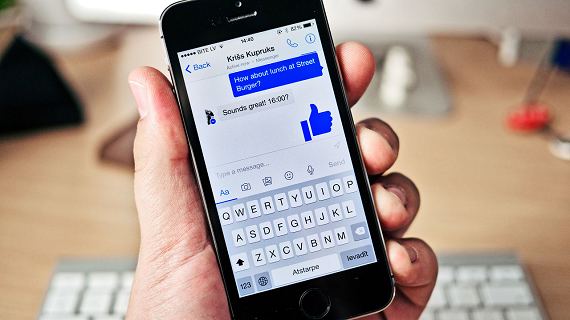
I laugh a little bit every time some new social network claims to be the one that will finally take down Facebook. It isn’t going to happen, at least not anytime soon. The reason is that it just has so many people, and that creates a network effect. Essentially, people go where others already are.
In its third quarter earnings report, released on Wednesday, Facebook said it now has 1.55 billion monthly active users on average. Out of the seven billion people who live on this planet, 22% of them are now using Facebook.
I didn’t think that anyone could argue about the company’s superiority in this area but apparently there was some question about what an active user actually is. (I’d actually rather they included more of its apps than just Messenger in the stat, such as Rooms, Paper and Slingshot.)
So Facebook has decided to update the metric. In an updated 10-Q with the Securities and Exchange Commission, the company now says this about what makes someone a monthly active user:
“We define a monthly active user as a registered Facebook user who logged in and visited Facebook through our website or a mobile device, or used our Messenger app (and is also a registered Facebook user), in the last 30 days as of the date of measurement. MAUs are a measure of the size of our global active user community.”
Seems simple enough, you access Facebook or Messenger at least one time during the month you’re an MAU. What’s different is that the company also used to count anyone who shared anything to Facebook from a third party app. So lets say you liked an article, you shared it to Facebook, but never actually went into the app itself, you were still counted.
This is how it was defined previously:
“We define a monthly active user as a registered Facebook user who logged in and visited Facebook through our website or a mobile device, used our Messenger app (and is also a registered Facebook user), or took an action to share content or activity with his or her Facebook friends or connections via a third-party website or application that is integrated with Facebook, in the last 30 days as of the date of measurement. MAUs are a measure of the size of our global active user community.”
As you might imagine, there is not a big difference in the numbers between the two. I mean, did anyone really think that many people used Facebook that way?
“MAUs from third party websites or apps integrated with Facebook were a really small part of previous quarters’ MAU numbers,” Vanessa Chen, spokesperson for Facebook, told me. “The impact wasn’t large.”
So why even bother to make this change?
“We simply wanted a cleaner metric,” said Chen.
The other unspoken answer: it’s also about money. This comes as Facebook is starting to make some headwinds in ad share, both worldwide and in the United States, gaining year to year while Google is starting to fall.
The company makes the vast majority of its funding off of advertising. Of the $4.5 billion it made in revenue this past quarter, advertising revenue accounted for $4.3 billion, a 45 percent increase from the same quarter the year before.
Revenue from payments and fees for the quarter was $202 million for the quarter, an 18 percent decrease year-to-year, and that number is going to shrink even further.
“We expect our total payments and other fees revenues to decline sequentially from Q3 to Q4, similar to the trend that we have experienced over the last couple quarters,” David Wehner, Facebook’s Chief Financial Officer, said in a conference call on Wednesday.
Facebook is the dominant social network right now. It has more people using it than its rivals combined. For comparison’s sake, Twitter has 320 million monthly active users, and LInkedIn has only 100 million. Facebook wants absolutely nobody, most importantly advertisers, to have any questions or doubts that it is juking the numbers.
This change was first noticed by TechCrunch.
(Image source: fastcompany.com)