It appears that all of those people liking your company page may not be people at all, according to a BBC investigation to see what would result from placing a fake company with poorly targeted ads on Facebook.
The experiment, conducted by BBC technology correspondent Rory Cellan-Jones, involved the setting up of a page for a fictitious UK company called ‘VirtualBagel Ltd‘ and the purchase of a Facebook ad.
Even though the company page included very little information and visuals, the page (created on July 4) amassed around 3,000 likes in just four days but the people liking this nonexistent UK company were primarily from Egypt, the Philippines and Indonesia.
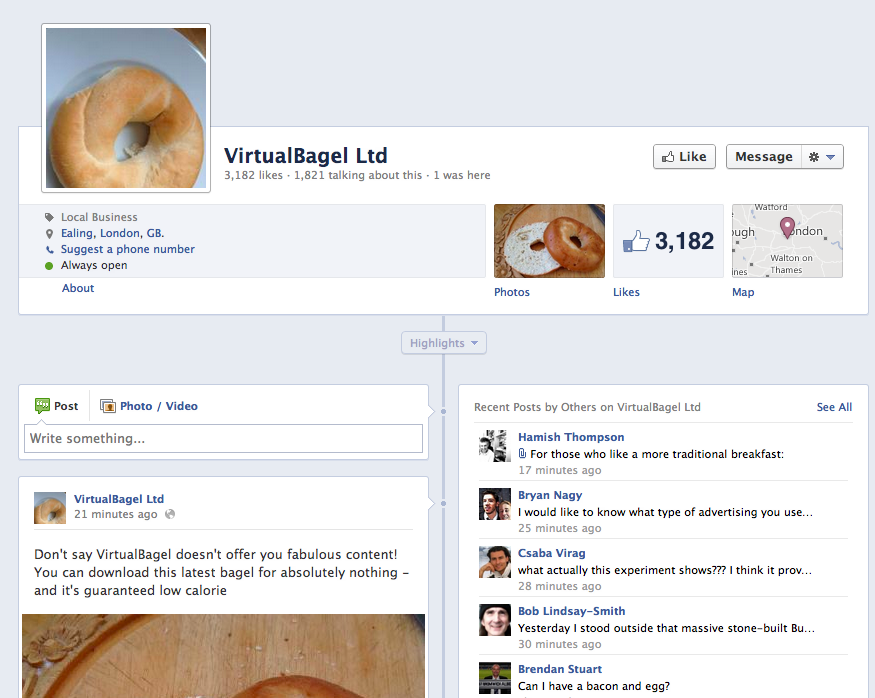
When Cellan-Jones dug further into these “fans,” he found that most were very clear phantom pages.
In the article following this Facebook advertising test, Cellan-Jones explained that these fake profiles and “likes” are often a way to get spam and malware spread — by liking someone’s page and then attempting to friend them.
With the majority of revenue for Facebook coming from advertising, the idea that 6% or more of the profiles on the site are fake is a concern and one that advertisers would like an answer to — especially if it could only get worse from here on out.
This experiment does shed some light on the fact that Facebook’s verification process is far shakier than it was in the company infancy. I remember being verified through a school email and ID in order to sign up for the social network and as the service grew, the verification process dropped drastically.
In fact, because my parents are password-challenged, they have multiple accounts that sit dormant while they use the most resent, active incarnation of their profiles.
It is clear that Facebook has sacrificed the security of the site to boost the usership and activity rate.
I would like to believe that this and, hopefully, future efforts to look at the the number of fake profiles helps them increase their verification process somehow, because companies that are advertising online are going to want some assurance that third-party companies, or Facebook itself isn’t setting up drone to like ads just to keep revenue up.
With the first public quarterly earnings report just around the corner, investors are going to want Facebook to address the concerns that the company advertising model still has too many flaws and inconsistancies. Hopefully Facebook will take the time and effort to address the matter of fake profiles and the attempted spread of malware through company pages.
(Image Source: UK FlightHype)