
We’ve gotten to the point now where not only does a company need a mobile strategy to succeed, but the term “mobile-first” is redundant. Every company is automatically mobile-first. They don’t have any other choice.
But with every investor tightening their purse strings, even mobile startup investing is getting hit. In the first three months of this year, investments into this sector dropped 39 percent year-over-year, according to data out from CB Insights.
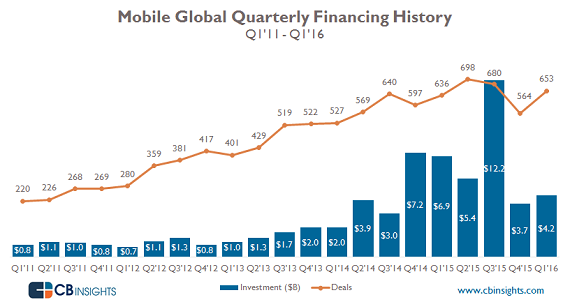
There was $4.2 billion invested in 653 mobile startups in the first quarter of this year, for a 13.5 percent increase in dollars over Q4. It was also a 16 percent increase in the number of deals, up from 564 in Q4, and up 2.7 percent from 636 deals in Q1 2015.
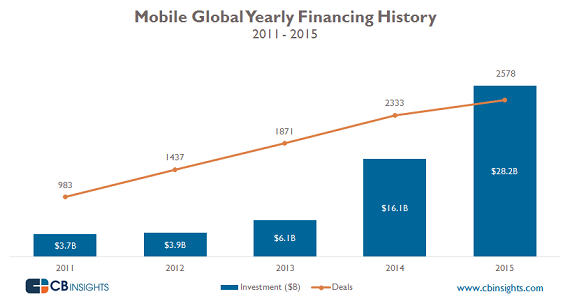
In all, there was $28.28 billion invested in these companies in 2015, across 2,578 deals. That represents an increase of 75 percent in dollars, up from $16.1 billion in 2014, and an 11 percent increase from 2,333 deals the year before.
Since 2011, deals have increased by 162 percent, growing from less than a thousand, while the amount of money invested has gone up by a whopping 662 percent in the same time frame.
With the amount of money growing at a much faster pace than the number of deals, the average deal size has also grown, going from $3.8 billion in 2011 to $11 billion in 2015, a 189 percent increase.
Funding to mobile startups peaked in the third quarter of 2015, with $12.2 billion invested; no other quarter has ever seen more than $7 billion. That was fueled by 17 mega-rounds of at least $100 million, including Didi Chuxing and Uber.
After Q3 is when the market began to crash, with deals falling to 564 in Q4, the lowest number since the beginning of 2014. Now things seem to be coming back, though they are still nowhere near where they were a year ago.
The mobile space also seems to be maturing. Even though each of the past five years saw early-stage companies take the majority of deals, that number is slowly coming down, falling every year since 2012. In 2012 it was 58 percent of deals that were in the seed/angel stage, but by 2015 it was down to 48 percent.
The early stages are also getting fewer dollars. In 2012, seed/angel deals represented 13 percent of dollars going to mobile startups, a number that has now fallen to only four percent. Series A went from being a quarter of all dollars, to only 11 percent in 2015.
Meanwhile, late-stage deals, which made up 21 percent of funding in 2012, more than doubled to 43 percent of dollars in 2015.
(Image source: mariadcampbell.com)
tightening