If you’re a blogger, editor or online writer, putting links in articles is pretty commonplace. But it’s a task that can take some time. So much time, in fact, that the idea of updating those links, much less links in old articles, isn’t even a consideration. That may change, however, with LinkSmart.
Boulder, Co.-based LinkSmart announced Wednesday that it’s come out of stealth mode and since inception in 2009 has raised $4.7 million in financing from Founder Group and Sutter Hill Ventures. While it’s been around for several years and has big media publishers as customers, it’s only now that the company is celebrating its existence and financing with an announcement.
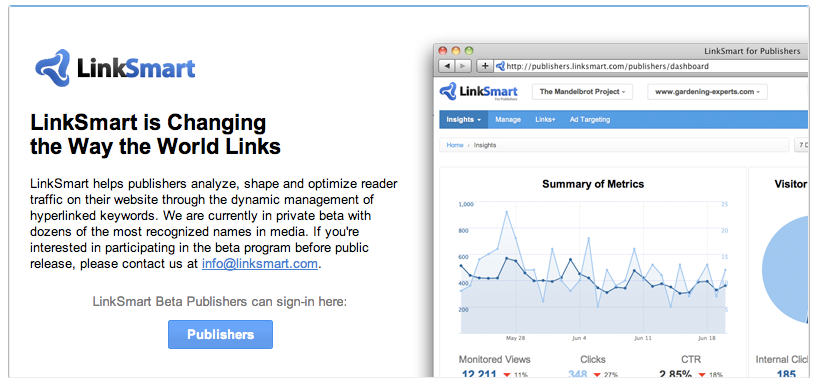
LinkSmart helps publishers put links in their stories so editors and writers don’t have to. It’s similar to in-text link services, such as Viglink, Kontera, Vibrant Media and Skimlinks in that service automates the hyperlinking of words in articles. But the difference is that the hyperlinked words don’t trigger a pop-up advertisement and are not linked to affiliate sites selling products. Rather the links are linked to other stories on the publisher site. Basically, LinkSmart helps recirculate traffic for publishers.
“LinkSmart enables publishers to leverage their existing traffic rather than go out to the public markets to acquire new traffic,” said Pete Sheinbaum, founder and CEO of LinksSmart, and former CEO of DailyCandy until it was sold in 2008 to Comcast Interactive Media.
Basically, LinkSmart’s service lets publishers dynamically link words across tens of thousands of stories. “You can upate destinations of keywords, without having to hardcode them into the system,” Sheinbaum explained. “If you have a website with tens of thousands of unique content, you’re not going to go back to change all the links… As your needs change [however] you can change the link just once.” And, all the links are updated.
So how does this work? For example, let’s say a publisher is running a special advertorial on Nutrogena. So as a publisher you’d want to drive as many clicks to that Nutrogena page. So all articles relevant to Nutrogena or lotion or other relevant words can be automatically linked to that page. With LinkSmart a publisher now can tap into old content that still gets a lot of traffic and use that content to drive traffic to the Nutrogena page.
“If you’re trying to get people to go to areas of the website, you’d have to employ additional editorial resources,” said Sheinbaum.
LinkSmart is an alternative solution to keeping existing readers on a site to acquiring new customers. While Sheinbaum wouldn’t disclose the price points for his media customers, Sheinbaum said that the service is significantly lower than spending money on search engine marketing (SEM). For instance, one company spending $10,000 a month on SEM might only have to spend $2k with LinkSmart to get high-value clicks by just recirculating the traffic already on the website.
The question is: Do those links actually produce clicks?
Interestingly enough, traffic that comes from SEO (search engine optimization) versus direct traffic gets higher CTRs (click-through-rates), said Sheinbaum. It’s probably the case because when people come to an article from search engines, they’re typically searching for something in particular and are clicking a lot to get the information. What this means is that direct traffic going to news stories, however, might not result in as many clicks as traffic going to evergreen content, like “how to” articles, or “best of” stories.
Overall, the CTRs for the in-text links can be 3% to 5% in some instances, said Sheinbaum. That compares to .3% or .5% CTRs for banner ads.
Sheinbaum also speaks from his experience at Daily Candy. At one point, while he was CEO, his team had to figure out how to drive more traffic from their newsletters to the company website. What they realized was that they saw more traffic coming from clicks in their newsletters than banner ads. Yet, most of the links were placed by hand. “99% of links are placed by hand,” said Sheinbaum. “They’re hard-coded in. But I was fascinated with how they perform.”