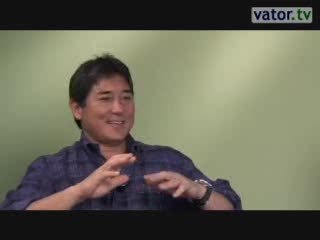
Guy Kawasaki on how to be Web famous

Follow your followers; be a prolific Twitter-er; answer all emails; be around for 25 yrs

Entrepreneur interview by Bambi Francisco Roizen
November 19, 2008 | Comments (5)
Short URL: http://vator.tv/n/484

Being famous is relative. These days, you can be famous on MySpace, Facebook, and Twitter. Or, you can use those platforms to launch yourself into Internet stardom. Who better to talk about how to become famous online but the ubiquitous Guy Kawasaki, whose Twitter following is fast approaching 30,000.

In this part III interview with Guy, the venture capitalist, author of "Reality Check," and co-founder of AllTop, we talk about his tricks to sustaining and growing his Web persona. (At the time of this filming, Guy had 21,000 followers. See our other interviews below.) 

First off, Guy admitted that fame and fortune don't happen overnight. "It took me 25 years to get famous," he said, humbly. That's what led to him to attract 21,000 followers on Twitter in nine months. 

So, how do you continue growing that base? I asked.

"Robert Scoble (who has 39k Twitter followers) told me that when someone follows you, you follow them," he replied. Kawasaki uses SocialToo, which enables you to automatically follow someone who's following you. Darn. And, I thought Kawasaki followed me on Twitter because he thought my Tweets were interesting. Guy is following more than 28,000 people on Twitter. 

Secondly, you should Twitter often. And, don't just use Twitter to promote yourself.

"When I find interesting links, or pages, or photographs, absurdities, I Tweet them all the time. People have accused me of promoting AllTop too much on Twitter… so, I conscientiously put in a lot of conent that has nothing to do with AllTop," he said. Use sites that can keep you informed. For instance, use AllTop and Stumbleupon, and "you will be a fascinating person," he added. "I don't care how dull you are."

Thirdly, answer your emails. "I answer my emails, all my directs and replies," he said. "That's the cost."

Bottom line, there is responsibility and maintenance to being a celebrity. 


Related companies, investors and entrepreneurs

Plogo_twitter-twitter_twitter
Twitter
Startup/Business
(6 ratings)
25179 views
Description: Where did the idea for Twitter come from? Jack Dorsey had grown interested in the simple idea of being able to know what his friends w...
90_70_default_profile_pic
Guy Kawasaki
CEO,
Alltop

Related news


5 comments

Robert MacEwan
Robert MacEwan, on November 19, 2008

Might I suggest John Chow, Shoemoney or Problogger as examples of newly famous webcelebs. John Chow comes to mind with his RSS feed number greater than that of my local small town newspaper. That's mind blowing. His monetization of these numbers is just as staggering. The upward trend continues with his latest mind numbing $30,000 a month from his blog johnchow.com.

Moving on to Guy, tonight he has 28,295 followers on Twitter. @Guy, I hate to bring this up, but you broke your promise to about not using a cellphone to access Twitter. Well, you used Twittelator in reply to Maria929. Twitterlator is an iPhone Twitter client. Hate that you have to see this Bambi.

Guy, I would like a shout out of sorts - Twitter, Pownce, YouTube or FaceBook - you pick the platform or I'm turning this iPhone use information over to Michael from T.C. :-)

P.S. Loved your Art of the Start book. Read it while vacationing in Samara, Costa Rica. Even put the suggestions to good use.

cheers,
Robert MacEwan

Signin to reply Robert


Anthony Mitchell
Anthony Mitchell, on November 20, 2008

Robert Scoble said that he doesn’t judge himself by who follows him (or how many), but rather by who he follows.

The best use of social media, especially from a brand management perspective, is to provide a means of listening.

If we are in the room to listen, does it matter who or how many people follow us? Why not follow people who have different interests from your own, so it becomes irrelevant whether they follow you back?

The very top ranked twitterati post only once or twice a day. This is because most Twitter users are not power users and are not using sorting tools of any kind. If a poster opens a hose, that person may find themselves unfollowed.

It’s ironic that many Twitter users find that they gain followers when they take a break from posting—and lose followers when they post.

Don’t be afraid to block people with inappropriate avatars, aliases, or content. About 5-10% of the people who I follow do not allow their postings to be seen publicly and do not allow new followers without permission.

Guy Kawasaki is a good person to follow because he mixes helpful information with occasional personal details, allowing readers to gain a sense of him as a whole person.

Scoble is harder to follow because ‘the force is strong with him’ and so is the content hose. One industry wag remarked, “the problem is not Scoble, the problem is unfiltered Scoble.”

Ann P. Mitchell (no relation) commented that some people use Twitter as a one-to-many instant messaging service rather than as a microblog. She didn’t say this, but others may find that to do so makes one’s tweets less relevant and the poster harder to follow.

I recommend following both Scoble and Kawasaki. However, not everyone in the Twatrix (the Twitter matrix) agrees:

“I'm a thought leader. My strategy is to follow everyone and then not read any of their tweets. Also LINKS! Here are links to some links.” RT @mayja

There’s nothing to see in my tweets:
http://twitter.com/aem76us

Signin to reply Anthony


Bambi Francisco Roizen
Bambi Francisco Roizen, on November 20, 2008

It's OK, Robert. I'm OK with Guy using Twittelator to reply to Maria929

Signin to reply Bambi


Bambi Francisco Roizen
Bambi Francisco Roizen, on November 20, 2008

That's a good way to look at it - you are who you follow :-), not who follows you. Actually, I have had a sort of similar strategy at LinkedIn. My goal was to be connected to the least number of people, but to have the largest network, meaning I only connected to people with significantly larger networks than myself.

Signin to reply Bambi


Robert MacEwan
Robert MacEwan, on November 20, 2008

Quality over quantity is more attractive on LinkedIn. Media company owners only.

Signin to reply Robert


Robert MacEwan
Robert MacEwan, on November 20, 2008

That comment was jokingly calling out Guy for breaking an agreement with Michael Arrington on the SocialToo arrangement they made. Guy was not supposed to be using a cellphone during the time he commented to Maria929 using software only developed for the iPhone. 8-) In other words he broke his agreement. Busted in a geeky sorta way.

Signin to reply Robert


Comment_gbg
Rachel Bowman, on September 2, 2009

A great book to consider if you're a fan of Guy's is 'Exploiting Chaos' by Jeremy Gutsche. You can take a look at the book at www.exploitingchaos.com if you're interested.

Signin to reply Rachel


Contribute to
If you are a thought leader, create your own channel and distribute your voice to our news partners.

Latest company updates on Vator.tv

Udemy's data was edited about 1 hour ago
Udemy’s $1M Fundraising: Lessons Learned about Pitching Investors from a First-Time Entrepreneur http://j.mp/9gEGBY
See more about 2 hours ago
The Golden Opportunity - Lynn Liss (Strategic Partnerships)
© 2010 Vator, Inc.